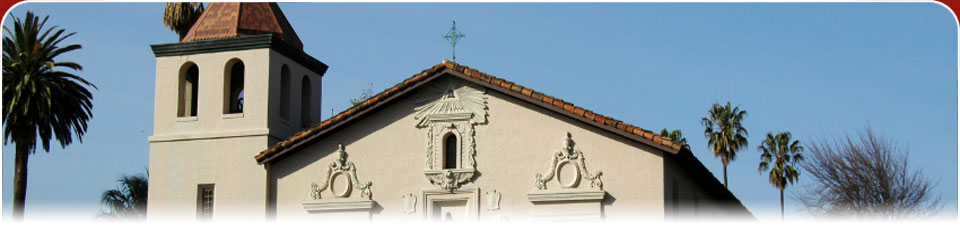
The history of Santa Clara before California existed as a state is rich and diverse. Santa Clara was founded in 1777 as Mission Santa Clara de Asis, one of California's 21 Spanish missions. The city was consequently named after the famous Mission. The original mission still stands today and is located on the beautiful grounds of Santa Clara University.
A Growing City
José Francisco Ortega arrived in the valley in 1769 and was the area's first European visitor. At the time Native Americans, called "Costanos" ("coast people") by the Spanish, were the original inhabitants of the area. They later came to be known as the Ohlone. Many Ohlone were converted to Christianity by the Spanish and lived and worked in the Missions.
One of the oldest adobe structures, Berryessa Adobe, in Northern California is in Santa Clara and is preserved as a registered historical landmark. Berryessa Adobe was built in the 1840s and is a simple adobe home located a mile west of Mission Santa Clara. It was occupied by generations of families who immigrated to Santa Clara to labor in the fields and factories.
In 1846 California became part of the United States with Santa Clara officially becoming incorporated in 1852 as part of Santa Clara County and state.
A Center for Education
Santa Clara and its neighboring cities have a history of being an educational center, attracting students from across the country. Santa Clara College was founded in 1851 by the Society of Jesus (Jesuits). Santa Clara College eventually became Santa Clara University which is a leading higher education institution in the area today.
From Family Farms to Semiconductors
The economy of Santa Clara centered around family-owned farms in the early days. Orchards and vegetables flourished in the area's fertile soil and in its heyday the Santa Clara Valley was the fruit bowl of the country. Santa Clara continued to grow as a city and in the 20th century its population reached 5,000. Santa Clara maintained that population through the early 1960s when the semiconductor industry became the first step towards creating Santa Clara's famed Silicon Valley.
High Tech Evolution
The semiconductor industry gave rise to other high-tech industries and as the population grew, triggered the boom of the construction industry in the area. The city's first medical hospital was built in 1963. New infrastructure in the form of roads and highways connected Santa Clara and helped make it a great place to visit or live in. Today, the city is a thriving center of culture, innovation and technology and attracts thousands of visitors each year.